12 October, 2011

Science That'll Take You on the Ride of Your Life !


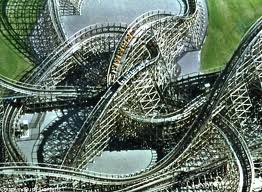
            Did you know that a roller coaster is more than just a scary – or fun – ride in an amusement park? That's right. While roller coasters are fun to ride, they are also very carefully designed using the science of physics.


Do you know physics is all about?
Physics is the scientific study of many things, such as motion, force, energy, light and sound. It includes gravity, friction and speed – all things that contribute to the way roller coasters operate.
Let's look a bit closer at how roller coasters came to be and what causes them to do the things they do. 
                                                The First Roller Coaster :


       The very first roller coaster wasn't like the ones we ride today – sleek metal cars travelling upside down and sideways at high speeds over water and way up in the sky. Instead, the original "scream machines" (as they are sometimes called) were huge wooden sleds that slid down ice-covered mountains !


       Roller Coaster Rides Get More Daring – and Faster!

            In the 1920s, roller coasters were a big draw at many large amusement parks, including ones in Chicago and on the beaches. Some reached speeds of well over 60 miles per hour. At this time, roller coasters were made out of wood.

  IN DISNEY LAND ;
            Roller coasters and amusement parks in general had a rough time of it. Many closed. But then, a man named Walt Disney had a dream – he wanted to build an amusement park that would be the greatest one of them all – and he did: Disneyland.

Theme Parks – and Coasters, Everywhere!

             Many followed Disney's lead and now there are theme, or amusement, parks everywhere. And, as new parks opened, new types of roller coasters were developed. Today, many roller coaster rides are much different from the original free-fall down a frozen slope comprising the first coaster.


The Scientific Theory Behind the Coasters

Roller coasters usually don't have engines. Surprised? Seems hard to believe, but most of them travel safely around the track strictly by using gravity, friction and speed.
How does that work?
It converts potential energy to kinetic energy – all of the energy a roller coaster needs to run around the tracks.
Huh?
Potential energy is easy to understand. It's the amount of energy an object possesses relative to it's mass and how high it is from the ground. Take a chapter from Issac Newton and drop an apple to the ground from a height of one foot, then two, then three and so on. Each time you drop the apple, you will have a more forceful landing because the apple's potential energy increases each time.
 
Fastest Roller Coasters
  Two of the fastest roller coasters are Steel Force and the Desperado.  The Desperado is in Buffalo Bills Resort, and Steel Force is in Dorney Park.  They both go 80 miles per hour.  They are the fastest coasters out of steel and wooden roller coasters.  The fastest looping roller coaster is the Viper.  It goes 70 miles per hour.

Tallest Roller Coasters
The two tallest roller coasters are Steel Force and the Desperado.  They are 225 feet tall.  They are the tallest out of wooden and steel roller coasters.  The tallest wooden coaster is Hercules.  It is 175 feet tall.  The first coaster to top 200 feet was Magnum XL-200.  There are only seven roller coasters currently operating that reach 200 ft. tall.  They are Magnum XL-200, The Pepsi Max Big One, The Desperado, Fujiyama, Wild Thing, Manhattan Express, and Steel Force.
Weird Things About Coasters
There once was a man who did not talk for six years because of shell shock, but after a ride on the Coney Island Cyclone, he told his friend, "I feel sick."  There used to be a roller coaster track that people could drive their car on.  A long time ago there was a roller coaster that jumped a gap, but it was banned because the jump would vary according to the weight of the people.  Some of the items people find under roller coasters besides wallets, change, and keys are glass eyes, fake legs, brassieres and false teeth.

Best Theme Parks
The park with the best and most roller coasters is Cedar Point in Sandusky, Ohio.  Six Flags Magic Mountain in Valencia, California and Six Flags AstroWorld in Houston, Texas each have ten roller coasters.  Six Flags Over Georgia in Atlanta, Georgia, Six Flags Over Great America in Gurnee, Illinois, Paramount Kings Island on Kings Island, Ohio, and Paramount Canada`s Wonderland in Vaughan, Ontario each have eight coasters.  
o l

So lets catch our ride ;)


Is social media a marketing dream?


If you don't know what social networking is, chances are you're not a member of a site! Synovate looked into who were members of sites, or not, and which sites they belonged to. Perhaps the biggest out-take here is the debunking of myth number two. Social networking is definitely not US-centric.
    Overall, 26% across the markets surveyed are members of social networking sites. This peaked with the Netherlands at 49%, United Arab Emirates (UAE) at 46%, Canada at 44% and the US at 40% (though keep in mind that's 40% of a huge population).


Sites of choice
        The survey then asked social networkers to name the sites they belong to. Some markets seemed to favour multiple memberships and some seemed to stick to one or two major ones. The markets where social networking aficionados favour signed up for many sites are UAE, India, Indonesia, and Bulgaria.


Now while coming to particular social networking sites ,  so far as I could gather the info  .. is here ! 
     As social media continues to gain acceptance as a communications platform, I thought it might be fun to have a cool fact about it for every week of the year .So, here are ten facts about the five most well-known social media outlets – Facebook, Twitter, LinkedIn, YouTube and blogging – with two more bonus facts thrown in just for fun :


Facebook

1. The average Facebook user has 130 friends.
2. More than 25 billion pieces of content (web links, news stories, blog posts, notes, photo albums, etc.) is shared each month.
3. Over 300,000 users helped translate the site through the translations application.
4. More than 150 million people engage with Facebook on external websites every month.
5. Two-thirds of comScore’s U.S. Top 100 websites and half of comScore’s Global Top 100 websites have integrated with Facebook.
6. There are more than 100 million active users currently accessing Facebook through their mobile devices.
7. People that access Facebook via mobile are twice as active than non-mobile users (think about that when designing your Facebook page).
8. The average Facebook user is connected to 60 pages, groups and events.
9. People spend over 500 billion minutes per month on Facebook.
10. There are more than 1 million entrepreneurs and developers from 180 countries on Facebook.
  

Twitter


11. Twitter’s web platform only accounts for a quarter of its users – 75% use third-party apps.
12. Twitter gets more than 300,000 new users every day.
13. There are currently 110 million users of Twitter’s services.
14. Twitter receives 180 million unique visits each month.
15. There are more than 600 million searches on Twitter every day.
16. Twitter started as a simple SMS-text service.
17. Over 60% of Twitter use is outside the U.S.
18. There are more than 50,000 third-party apps for Twitter.
19. Twitter has donated access to all of its tweets to the Library of Congress for research and preservation.
20. More than a third of users access Twitter via their mobile phone.
LinkedIn


21. LinkedIn is the oldest of the four sites in this post, having been created on May 5 2003.
22. There are more than 70 million users worldwide.
23. Members of LinkedIn come from more than 200 countries from every continent.
24. LinkedIn is available in six native languages – English, French, German, Italian, Portuguese and Spanish.
25. Oracle’s Chief Financial Officer, Jeff Epstein, was headhunted for the position via his LinkedIn profile.
26. 80% of companies use LinkedIn as a recruitment tool.
27. A new member joins LinkedIn every second.
28. LinkedIn receives almost 12 million unique visitors per day.
29. Executives from all Fortune 500 companies are on LinkedIn.
30. Recruiters account for 1-in-20 LinkedIn profiles.

YouTube


31. The very first video uploaded was called “Me at the Zoo”, on 23rd April 2005.
32. By June 2006, more than 65,000 videos were being uploaded every day.
33. YouTube receives more than 2 billion viewers per day.
34. Every minute, 24 hours of video is uploaded to YouTube.
35. The U.S. accounts for 70% of YouTube users.
36. Over half of YouTube’s users are under 20 years old.
37. You would need to live for around 1,000 years to watch all the videos currently on YouTube.
38. YouTube is available in 19 countries and 12 languages.
39. Music videos account for 20% of uploads.
40. YouTube uses the same amount of bandwidth as the entire Internet used in 2000.

Blogging


41. 77% of Internet users read blogs.
42. There are currently 133 million blogs listed on leading blog directory Technorati.
43. 60% of bloggers are between the ages 18-44.
44. One in five bloggers update their blogs daily.
45. Two thirds of bloggers are male.
46. Corporate blogging accounts for 14% of blogs.
47. 15% of bloggers spend 10 hours a week blogging.
48. More than half of all bloggers are married and/or parents.
49. More than 50% of bloggers have more than one blog.
50. Bloggers use an average of five different social sites to drive traffic to their blog.

Bonus Facts

51. 90% of Internet users know at least one social network.
52. The average social user has 195 friends.
Privacy and predators
          But the survey was not all about debunking myths. It also confirmed facts. Like, privacy concerns and fear of strangers remain barriers to complete online comfort for a great many of our respondents.
         Overall, just over half our respondents who are members of social networking sites (51%) agreed that online social networking has its dangers. 


"Online communication is as meaningful as face-to-face communication."